
The Branding Damage of Ghost Jobs
Ghost Jobs are no longer a HR issue but a branding dilemma affecting your customer experience
You open your email to see the dreaded line, "We're sorry to inform you that we've decided to move forward with another candidate." This is clearly not the news you wanted, but at least it's an ending.
Increasingly, however, job seekers never receive a conclusion. After investing hours tailoring résumés, preparing for interviews, and meeting with hiring managers, many candidates simply... hear nothing. The position quietly disappears, is reposted a week later, or remains open indefinitely. Welcome to the growing world of ghost jobs.
For many organizations this may seem like little more than an unfortunate recruiting practice, but the real cost has nothing to do with recruiting at all. Every interaction with a company shapes its brand. Businesses meticulously measure customer journeys, Net Promoter Scores, and service recovery efforts because they understand that experiences influence purchasing decisions. Yet the hiring process, which is often one of the most personal interactions someone has with a company is frequently treated as an isolated HR function rather than a brand experience.
This exploratory study examines whether ghost jobs create consequences beyond frustrated job applicants and hurt feelings. Specifically, it investigates whether poor hiring experiences damage perceptions of leadership, erode trust in an organization's culture, influence future purchasing behavior, and ultimately become a hidden customer experience problem that is disguised as a recruiting issue.
What Exactly is a Ghost Job?
Ghost jobs (also called fake or phantom jobs) are positions advertised without leading to a real hire or leaving candidates in limbo after interviews. They can include postings where the employer is “always hiring,” roles kept open indefinitely, or positions advertised to create the impression of growth despite hiring being frozen. A 2024 study by recruiting platform Greenhouse Software found that at least one in five U.S. job postings is fake or never results in a hire, indicating ghost jobs account for at least 20% of listings.
For purposes of this study, a ghost job is defined as a job where an applicant had at least one interview with the company and then had communication cease for no apparent reason.
Why Companies Have Ghost Jobs?
There are several reasons for ghost jobs:
Talent pipeline building- Many employers use ghost jobs to collect résumés and build a candidate pool for future needs, even when they have no approved headcount.
Signaling growth and stability- Some firms keep jobs posted to suggest they are expanding or financially healthy, which can influence investor, customer, or public perceptions.
Internal politics and flexibility- Hiring managers may want “options on the bench” in case budgets open up or an existing employee leaves, or HR teams may be pressured to look busy by showing many open roles.
Unfocused job description- Uncertainty of HR and the hiring manager of what the job duties actually are. The job search process is used to define the qualifications for the position.
Known Effects on Labor Market and the Possible Hidden Cost
Existing research has identified the following effects of the ghost jobs:
Ghost jobs affect existing employee morale and retention. When current employees realize their company advertises roles that are not going to be filled, they may feel the organization is manipulating their employees and misleading the public, which can damage trust and prompt them to look elsewhere.
For the job seeker, ghost jobs waste time and create emotional strain. Job seekers invest significant effort in tailoring applications, preparing for interviews, and waiting for responses, only to learn the role is not truly available, which leads to frustration and discouragement.
Discovering that many postings are ghost jobs erodes confidence in companies and job boards, causing candidates to disengage or overlook legitimate opportunities, and reinforces the belief that “the market is broken.”
While it seems that the word is out on ghost jobs as 80% of job seekers report actively avoiding companies that they know post ghost jobs (Clarify Capital, 2025), it appears that ghost jobs may have a hidden cost for the companies that post them, particularly to their reputation and overall consumer satisfaction.
Survey Methods
We reached out to local job search groups in the Cleveland, Ohio area. These groups are populated by active job seekers. They were asked if they had encountered a ghost job during their job search and if so, would they like to provide feedback about the experience. There were 30 active responses. Data was collected via a google form survey and in-person interviews.
Job Applicant Profile
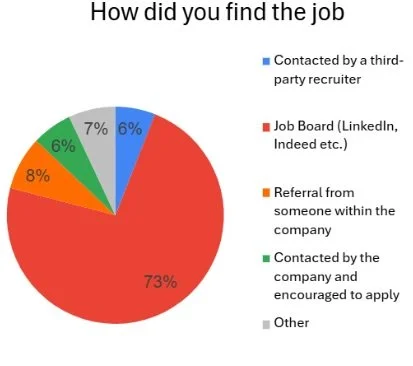
The respondents generally had a favorable opinion of the company before applying with a score of 8.1 (where 1= Not Reputable and 10=Very Reputable). LinkedIn (73%) was by far the most popular method of finding the position.
Most applicants had more than one interview, with one-third having three or more interviews (Table 1). In those interviews, 60% spoke to the hiring manager.
How many interviews did you have with the company?
| Interviews | Percentage |
|---|---|
| 1 | 40% |
| 2 | 27% |
| 3 | 13% |
| 4 or more | 20% |
Reputation Damage
While most of the applicants initially viewed the company favorably (8.1), once they were ghosted, their view of the company deteriorated in several different areas.
The hiring integrity of a company diminishes when applicants are ghosted. When asked about hiring transparency, applicants rated the ghosting company with a transparency score of 3.4 (where 1= No Transparency and 10=Very Transparent). A high percentage of respondents indicated that ghosting influenced how they viewed the leadership for that company, with almost half indicating that ghosting had a significant change and resulting in an overall score of 8.6 (Table 2).
If a company fails to respond after an in-person interview, how much does your respect for their leadership change?
| Change | Percentage |
|---|---|
| 1- no change | 0% |
| 2 | 0% |
| 3 | 0% |
| 4 | 5% |
| 5 | 2% |
| 6 | 7% |
| 7 | 7% |
| 8 | 20% |
| 9 | 13% |
| 10- significant change | 47% |
Furthermore, this decline in respect carries over to the company itself as 73% believe hiring practices (good or bad) are a true reflection of internal culture. A bad hiring expeience imprints on the applicant long after the interview cycle ends. A common occurrence is seeing the same (or very similar) job posted shortly after being ghosted. A large majority indicated that this action also further impacts their trust in the company with almost 90% indicating a sizeable impact (Table 3).
If you saw this same role reposted shortly after ghosting, how would that impact your trust in the company?
| Impact | Percentage |
|---|---|
| 1- no impact | 6% |
| 2 | 0% |
| 3 | 0% |
| 4 | 0% |
| 5 | 0% |
| 6 | 3% |
| 7 | 4% |
| 8 | 18% |
| 9 | 19% |
| 10- significant impact | 50% |
When asked to compare hiring etiquette to other companies, most indicated that they believed that the ghosting company was worse than others. This indicates that most still believe that ghosting is an anomaly and is not the norm and that other companies are less likely to practice job ghosting (Table 4).
Compared to other companies in the same industry, how would you rank this company’s hiring etiquette?
| Rating | Percentage |
|---|---|
| 1- much worse than others | 13% |
| 2 | 0% |
| 3 | 33% |
| 4 | 20% |
| 5 | 27% |
| 6 | 7% |
| 7 | 0% |
| 8 | 0% |
| 9 | 0% |
| 10- much better than others | 0% |
These changed attitudes towards a ghosting company seemed to also affect future job search behavior. Most expressed reluctance to apply for a different role in future with a score of 3.4 (where 1= Not very likely to apply and 10=Very likely to apply).
Business Implications and Negative Branding
Ghosting affects more than applicant perceptions and job search behavior; it may also damage a company's reputation, brand, and customer behavior.
A majority of respondents indicated that they were likely to share their negative experience with their professional network, with just under half (47%) being extremely likely to do so (Table 5).
Based on this experience, how likely are you to speak negatively about this company to your professional network?
| Likelihood | Percentage |
|---|---|
| 1- not very likely | 0% |
| 2 | 0% |
| 3 | 7% |
| 4 | 6% |
| 5 | 2% |
| 6 | 13% |
| 7 | 12% |
| 8 | 14% |
| 9 | 20% |
| 10- extremely likely | 27% |
The average score for speaking negatively was 7.7. It appears that the further an applicant gets in the interview, the more likely they are to share their negative experience. For example, talking to the hiring manager indicated a slightly greater inclination to speak negatively about the company (8.1) versus those who did not talk to the hiring manager (7.2).
In addition to sharing their negative experience with their professional network, most indicated that their negative experience would also affect their own consumer behavior. Eighty percent of respondents indicated that a poor hiring experience would greatly diminish their likelihood of purchasing future products or services from that company.
Conclusion
Ghost jobs are often viewed as an HR issue. The evidence from this study suggests they should also be viewed as a brand issue. Being ghosted in the hiring process harms a company in two connected ways: it lowers reputation among applicants and can reduce customer goodwill.
While job rejection is nothing new, ghosting represents a very impersonal response to a very personal experience. When people are wounded psychologically, they respond in the only avenues available to them. When asked to describe their experience in one word, the most common sentiments were "Frustration" and "Disappointment". These are not malicious emotions.
Future studies should look to see if these behaviors are an effort to search for justice in an environment that seems unjust and personal. This sense of injustice is summed up by this respondent comment; "I did everything according to the recruiter’s instructions. I should have heard back within a few days... She never responded to my weekly contacts, and it took nearly 3 MONTHS to get rejected."
The findings paint a remarkably consistent picture. Candidates who experienced ghosting didn't simply walk away disappointed: they questioned leadership integrity, viewed company culture more negatively, became reluctant to apply again, shared their experiences with professional networks, and, perhaps most concerning, reported they were less likely to purchase products or services from those organizations. The damage didn't end when the interview did. It followed the company into the marketplace.
For years, customer experience professionals have emphasized that every touchpoint matters. This research suggests that the hiring process deserves to be added to that list. Applicants may never become employees, but they remain consumers, influencers, advocates, critics, and members of the same communities companies hope to serve. Treating them with professionalism isn't simply good recruiting etiquette; it's good business.
Perhaps the most important finding is also the simplest: people can eventually accept rejection, but they struggle to accept being ignored. A thoughtful rejection email (that is not a legal form letter) may close a hiring process, but silence leaves candidates to write their own ending. The main pattern is that silence is interpreted as disrespect. Once that happens, the hiring process stops being an HR issue and becomes a brand issue that asks one question: "If every interaction is part of your brand, why would the hiring process be the one place where silence is allowed to speak for you?"
Sources
https://clarifycapital.com/ghost-jobs
https://www.greenhouse.com/blog/greenhouse-2024-state-of-job-hunting-report