
Academic Activation Methodology
Our proprietary process has been refined from years of both univeristy reseach and business agency experience.
The Academic Activation Methodology Process
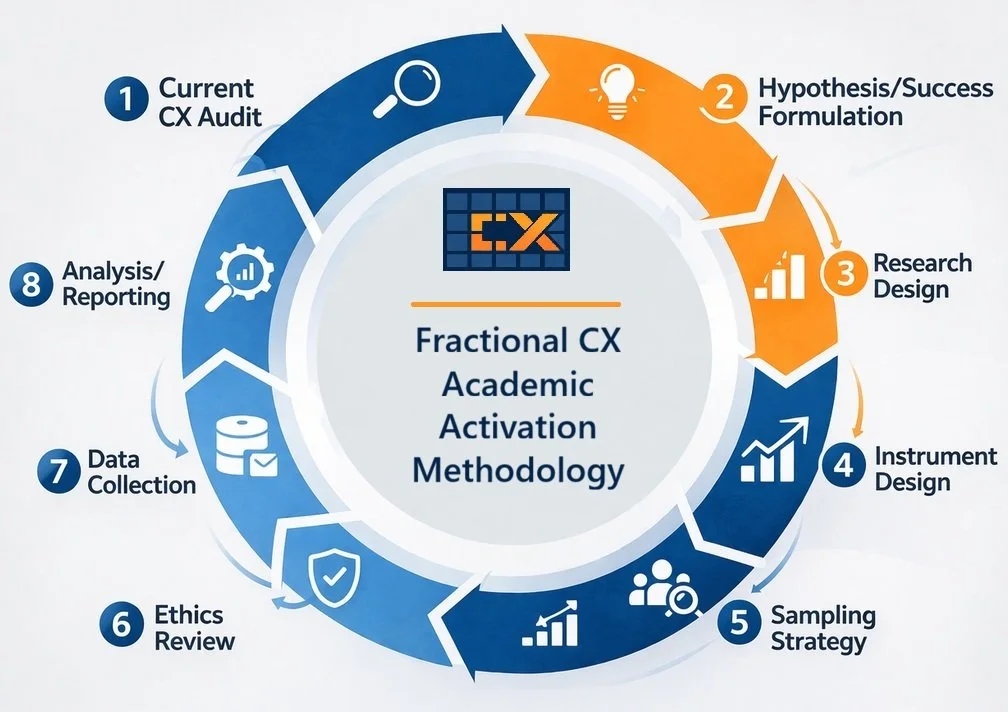
Conduct a diagnostic of existing CX activities, data sources, and touchpoints to identify strengths, gaps, and misalignments with customer needs and business objectives. This establishes a factual baseline and prevents duplicative or low-value efforts.
Current CX Audit
Architect the overall CX research framework, including which experiences to measure (journeys, touchpoints), cadence (transactional vs. relational), and integration with existing operational systems. The goal is a scalable system and satisfaction model that captures meaningful data across the customer lifecycle.
Research Design
Define clear success criteria tied to both customer outcomes (e.g., satisfaction, loyalty, effort) and business impact (e.g., retention, revenue growth). Align stakeholders on KPIs and decision-use so the program is outcome-driven, not just insight-generating.
Success Formulation
Develop surveys or feedback mechanisms that are concise, unbiased, and aligned to key CX metrics and drivers to create a concise satisfaction model that highlights areas of high impact. Questions are structured to capture both quantitative scores and actionable verbatim feedback without creating respondent fatigue.
Instrument Design
Define who will be surveyed, when, and how often to ensure representative and statistically reliable insights. This includes balancing coverage across segments, channels, and moments that matter while minimizing over-surveying.
Sampling Strategy
Ensure the program adheres to data privacy, consent, and ethical research standards (e.g., transparency, anonymity where appropriate) with a particular focus on the use of AI. This protects customer trust and ensures compliance with legal and organizational policies.
Ethics Review
Execute the deployment of surveys and feedback channels across selected touchpoints, ensuring high response rates and data quality. Monitor fieldwork in real time to address issues such as low participation or technical barriers.
Data Collection
Transform raw data into insights by identifying trends, key drivers, and root causes of customer perceptions and behaviors using both mutivariate and AI analyis methods. Advanced techniques may be applied to link CX metrics to operational and financial outcomes.
Analysis
Deliver clear, role-based insights through dashboards and storytelling that drive action across the organization. Reporting emphasizes not just “what happened,” but “what to do next” to improve the customer experience.
Reporting