
Meeting Expectations is not the Same as Customer Satisfaction, and Why Does it Even Matter?
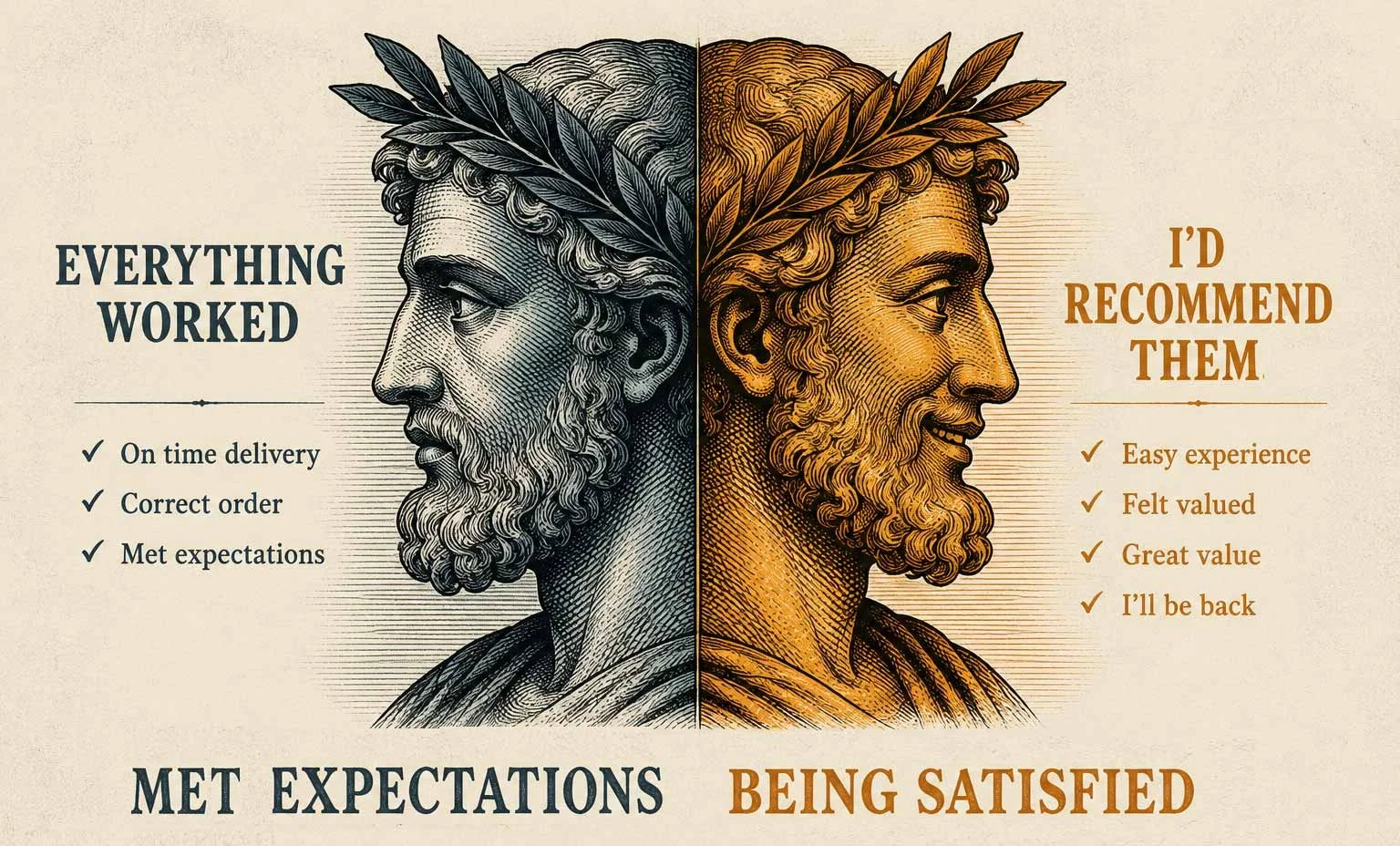
One of the biggest misconceptions in customer experience is treating meeting expectations and customer satisfaction as interchangeable concepts. While they're certainly related, they measure two very different psychological reactions. Organizations that fail to recognize this difference often wonder why customers continue to leave despite consistently delivering what they promised.
What Does "Meeting Customer Expectations" Mean?
Meeting customer expectations means "delivering the product, service, or experience in a manner the customer anticipated before the interaction occurred.” Those expectations are shaped by many factors:
Previous experiences
Marketing and advertising
Online reviews
Competitor experiences
Brand reputation
Word-of-mouth recommendations
If a customer expects a package in three days and it arrives in three days, you have met expectations. If they expect friendly service and receive friendly service, you have met expectations. This definition says nothing about how the customer feels afterward. Meeting expectations is fundamentally a comparison between what was anticipated and what was delivered.
What Is Customer Satisfaction?
Customer satisfaction is the customer's overall emotional evaluation of whether the experience was worthwhile, valuable, and beneficial. Satisfaction answers a different question: "Was this experience good enough that I'm happy I chose this company?"
A satisfied customer is not simply checking off a list of promises kept. They are making a broader judgment about value. That judgment includes factors such as:
Emotional response
Ease of doing business
Confidence in the purchase
Problem resolution
Value received for the money spent
Whether the experience improved their situation
Satisfaction is less about whether expectations were fulfilled and more about whether the customer feels positive after everything is over.
Why These Concepts Get Confused
It is easy to see why organizations lump these ideas together. Often, in the same direction. Poor performance usually creates low satisfaction. Excellent performance often creates high satisfaction. But they are not measuring the same thing.
Think of meeting expectations as keeping a promise.
Think of satisfaction as earning appreciation.
As the matrix below can attest, you can keep every promise and lose a customer and on the flip side you can make a mistake and still create loyalty.
|
|
High Customer Satisfaction |
Low Customer Satisfaction |
|
Expectations Met
|
Functional and Memorable The company delivered on its promises and created a positive emotional experience. |
Functional but Forgettable The company did what it said it would do, but nothing about the experience created enthusiasm. |
|
|
Customer reaction: |
Customer reaction: |
|
|
Business outcome: |
Business outcome: |
|
|
|
|
|
Expectations Not Met
|
Service Recovery Success |
At Risk Customers |
|
|
Customer reaction: |
Customer reaction: |
|
|
Business outcome: |
Business outcome: |
The Takeaway
Meeting expectations earns a company the right to compete for a customer. Creating customer satisfaction earns the right to keep that customer.
Meeting expectations alone does not guarantee satisfaction.
Failing to meet expectations does not automatically produce dissatisfaction if the recovery experience is exceptional.
The upper, right quadrant ("Functional but Forgettable") is where many organizations unknowingly operate. They consistently deliver what they promised, yet customers feel little emotional connection and are easily lured away by competitors.
The goal is not simply to move customers into the "Expectations Met" row; it is to move them into the "Functional and Memorable" quadrant, where operational excellence is paired with an experience that customers genuinely value.
Four Scenarios Every Business Should Understand
Here is an example how the four quandrants play out in real world scenarios.
1. Expectations Met + High Satisfaction
This is the ideal outcome. The company delivers exactly what was promised while making the experience easy, pleasant, and valuable. Customers are likely to return and recommend the business.
2. Expectations Met + Low Satisfaction
This surprises many executives. The company technically delivered everything it promised.
Yet customers leave thinking:
"It was fine."
"Nothing special."
"I'll probably shop around next time."
The expectation box was checked. The emotional value box was not. Customers in this case are very likely to switch if something more appealing comes along.
3. Expectations Not Met + High Satisfaction
This seems impossible, but it happens more often than people realize. Imagine your flight is delayed. Your expectation was not met. But the airline communicates proactively, provides meal vouchers, rebooks your connection before you ask, and keeps you informed throughout the delay. The original expectation failed. The recovery experience exceeded what customers thought was possible. People frequently remember great recoveries more positively than flawless transactions.
4. Expectations Exceeded + Low Satisfaction
This one catches organizations off guard. Suppose a luxury hotel upgrades your room. Great surprise. But the room is not clean, or something is off. Technically, expectations were exceeded in one dimension while the overall experience still left the customer dissatisfied. Satisfaction is holistic. Customers evaluate the entire journey, not isolated moments.
The Hidden Danger of Only Measuring Expectations
Many organizations celebrate because survey results show that they consistently meet customer expectations. Yet they continue to experience:
High customer churn
Weak loyalty
Increased price sensitivity
Limited referrals
Poor online reviews
If you are shipped the correct product, and nothing is damaged. You probably would not rave about the experience. You would simply think: "That's what was supposed to happen." Reliability earns trust. It does not automatically create enthusiasm. Enthusiasm comes from emotional involvement.
Satisfaction Includes Emotions
Behavioral scientists have long understood that people do not remember experiences like accountants.
They remember peaks.
They remember frustrations.
They remember surprises.
They remember how problems were handled.
That is why two customers receiving identical service can report very different satisfaction levels. One feels valued. Another feels processed. Same transaction. Different emotional outcome. Meeting expectations lives in the execution while satisfaction lives in your emotions. I personally still seek out second-hand Peugeot bicycles because it was the first real bicycle I bought with my own money, and and the old guy running the shop treated a 16-year old kid who walked in cold off the street like a real customer. The bike lived up to expectations (and I still have it), but I will remember that shop owner forever.
Why Businesses Need Both Metrics
Organizations that only monitor satisfaction may miss operational failures hidden beneath generally happy customers. Organizations that only measure expectations may miss growing emotional disengagement that eventually leads customers to defect. The strongest customer experience programs evaluate both.
Meeting expectations helps answer:
Are we reliably delivering on our promises?
Where are operational gaps occurring?
Which processes are failing customers?
Satisfaction helps answer:
Are customers glad they chose us?
Would they choose us again?
Are we creating loyalty instead of mere transactions?
Together, these metrics provide a much more complete picture of the customer experience.
Bringing Expectations and Satisfaction Together
If businesses want to excel, they need to manage both dimensions intentionally. Start by making expectations realistic. Overpromising may create initial excitement, but it also raises the bar that operations must clear every time. Honest marketing and consistent service standards create expectations that can be fulfilled.
Next, obsess over execution. Customers should receive exactly what they were promised, every single time. Reliability is the foundation of trust, and without it, satisfaction is difficult to sustain.
Then shift your attention beyond operational excellence. Satisfaction grows when interactions feel effortless, when employees demonstrate empathy, when issues are resolved quickly, and when customers sense that the organization values their time. These are the moments that transform a routine transaction into a positive experience.
Finally, measure the two concepts separately. Ask customers whether the company delivered what they expected but also ask whether they are satisfied with the overall experience. When the results diverge, the gap often reveals the most important improvement opportunities. A business that consistently meets expectations but struggles with satisfaction may need to improve emotional connection, ease of doing business, or perceived value. Conversely, strong satisfaction paired with inconsistent expectation fulfillment may indicate that service recovery is masking underlying operational problems.
Final Thoughts
Meeting customer expectations is about delivering what you promised. Customer satisfaction is about how customers judge the value of the entire experience after it is over. Businesses need both. Meeting expectations establishes credibility and trust. Satisfaction creates preference, loyalty, and advocacy.
The organizations that outperform their competitors understand this distinction. They do not settle for simply checking the boxes on a customer's expectations; they strive to leave customers feeling confident that they made the right choice. In today's competitive marketplace, that difference is often what separates companies that retain customers from those that merely complete transactions.