
Why build a customer experience movie studio when there is Netflix for your CX program.
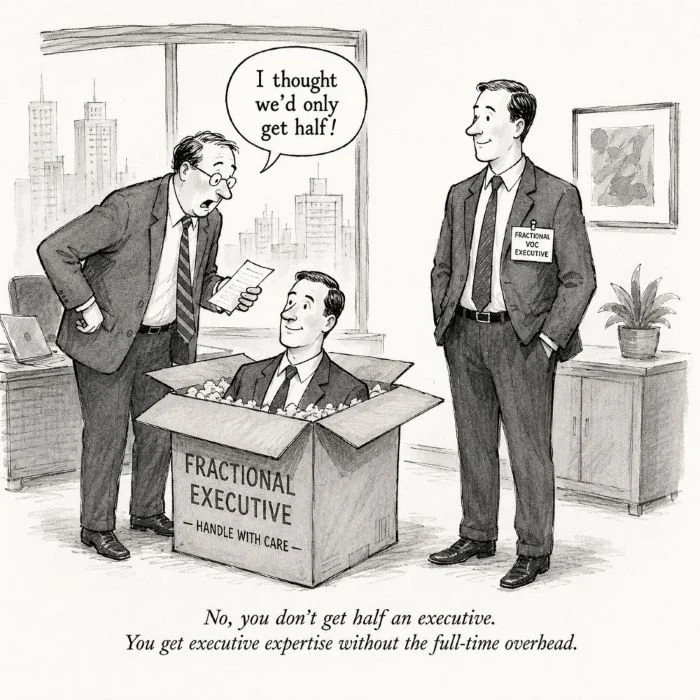
So…What Exactly Is a Fractional Voice of the Customer Executive?
If you've ever caught yourself thinking:
"We know customer experience is important, but do we really need another executive?"
"Can't we just send a survey and call it a day?"
"What in the world does 'fractional' even mean?"
These are the same questions many business leaders ask before they dip their toes into Voice of the Customer (VoC) research. And honestly, they're fair questions.
First Things First: No, "Fractional" Doesn't Mean You Get Half an Executive
Nobody is mailing you the top half of a Chief Customer Experience Officer. A fractional executive is simply an experienced leader who works with organizations on a part-time basis. Think of it as executive expertise without the executive-sized payroll.
You gain access to years of experience designing customer listening programs, analyzing feedback, and turning customer sentiment into business decisions, without adding another full-time salary and benefits package to the budget.
It is kind of like subscribing to Netflix instead of building your own movie studio to watch movies.
But Aren't Surveys Enough?
Ah yes, the old "we already have SurveyMonkey" argument. Collecting feedback isn't the hard part. The business world is overflowing with surveys, comment cards, NPS scores, support tickets, online reviews, CRM notes, and enough spreadsheets to wallpaper an office.
The challenge isn't gathering customer opinions. The challenge is figuring out what they actually mean, and more importantly, what to do about them. That's where Voice of the Customer programs separate themselves from "random acts of data collection."
Good VoC programs connect customer feedback to business outcomes. They uncover why customers stay, why they leave, and where friction is quietly costing revenue. In other words, they turn "interesting comments" into "actionable intelligence."
Does size matter?
Surprisingly, many small and mid-sized organizations are ideal candidates. They know customer experience matters. They know unhappy customers rarely send a formal resignation letter before disappearing. And they know they don't necessarily need a permanent VP of Customer Experience sitting in every Monday morning meeting.
What they need is expertise. Enough expertise to:
Evaluate their current customer experience efforts.
Design meaningful research.
Build listening systems.
Analyze results.
Prioritize improvements.
Help leaders make better decisions.
In many cases, that doesn't require forty hours a week forever. It requires the right experience at the right time.
What Does a Typical Engagement Look Like?
Contrary to popular belief, fractional executives don't arrive with a 400-slide PowerPoint deck and disappear into the sunset (At least the good ones don't). A typical engagement often starts with understanding what's already in place:
Existing surveys.
Customer comments.
Operational data.
Retention trends.
Current pain points.
From there, the focus shifts to building a practical roadmap—not creating research for research's sake. Because nobody wakes up in the morning hoping to buy more dashboards. Businesses want answers. And ideally, answers that don't require a PhD in statistics to understand.
How Long Does It Last?
Another common misconception is that fractional engagements are forever. They're not.
Some organizations need help launching a Voice of the Customer program. Others need someone to revitalize an existing one. Some simply need executive guidance during a period of growth. The level of involvement scales with the business.
Think less "lifetime commitment" and more "experienced guide."
The Smart Objections
The most useful objection is this one: “Couldn’t we just do this internally?” Sometimes yes, but only if your team has the time, the method, and the authority to turn research into change.
Another fair concern is whether a fractional leader will be too detached. The fractional should be integrated enough to lead, coach, and align stakeholders, while still remaining flexible and efficient.
A final question worth asking is, “How do we know it’s working?” Success should look like clearer priorities, better customer insight, stronger team capability, and a CX function that is more mature and less reactive.
Will It Actually Save Money?
Consider the alternatives:
Hiring a full-time executive.
Hiring multiple specialists.
Spending months recruiting.
Buying technology no one uses.
Collecting mountains of feedback that never influence decisions.
The cost of misunderstanding customers is often far greater than the cost of listening to them effectively. Customer churn, declining loyalty, and missed opportunities rarely show up with flashing warning lights. They usually sneak up quietly.
Which is precisely why organizations invest in Voice of the Customer programs in the first place.
The Real Question
The best questions to ask are not “Can they run a survey?” but:
Can they connect customer feedback to business priorities?
Can they work as part of the leadership team, not on the sidelines?
Can they leave behind a stronger, more self-sufficient CX function?
VoC work is only valuable when it changes something because customers are already telling us what they need. The only question is whether we're listening, or just admiring another dashboard.
Hiring a fractional executive for Voice of the Customer research is not about renting a fancy title. It’s about bringing in senior CX leadership that can turn disconnected feedback into decisions, playbooks, and measurable improvement.