
Why "Statistically Significant" doesn't mean what you think it means…except for when it does.
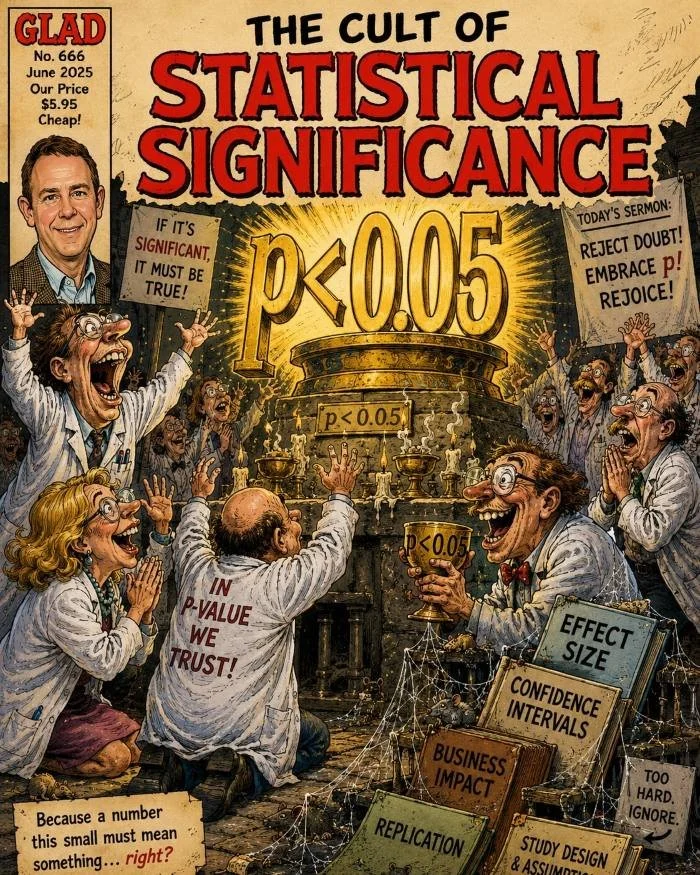
Most of us have read a research study and immediately started making decisions based on it.
"This software platform increases sales 20%!"
"Customers engagement increases 10% with this new feature!"
"Employees who attend this training are more productive!"
The report said it, so it must be true, right? Well…maybe. And on the other end the report did not meet statistical significance, so it must be discarded? Well...maybe!
Welcome to modern research, where billions of dollars, academic reputations, and whether your company adopts that shiny new AI-powered platform often hinges on the statistical significance of your data. Statistical significance is not a truth detector. It is more like a smoke alarm. Sometimes it alerts you to a genuine fire. Sometimes it's reacting to someone burning toast.
And occasionally, people unplug the smoke alarm entirely and proceed to make decisions based on wishful thinking, slick PowerPoint animations, and good vibes.
Why Statistical Significance Matters
Why bother with bothersome statistics anyway? Without statistical significance, organizations would constantly chase random fluctuations in data.
A marketing campaign has been performing well for a month. Should we double the budget?
Customer satisfaction rises two points. Can we declare success?
Sales dip for a quarter. Is it time to replace the entire management team?
Us humans are natural pattern seekers. We desperately want every wiggle in a chart to mean something. Unfortunately, randomness has other plans. Statistical significance exists because sometimes things happen purely by chance, and acting on those random blips can be incredibly expensive.
The danger is not just putting too much faith in significant findings; it is also putting faith in findings that are not significant at all.
Statistical Significance as a Buddy Cop Movie
Think of significance as two partners working together:
The p-value is the overzealous detective, making sure the rules are followed.
The confidence interval is the experienced partner who keeps everyone from making a rash decision.
You need both.
1. The p-Value: AKA- The Gatekeeper
The p-value answers one question: "Could this result have happened purely by random chance?"
Let us take a quick peek into the statistics classroom to better understand what a p-value is. For every statistical test, there is a baseline hypothesis (called the null hypothesis), and it usually says something like, “there is no real difference,” “there is no effect,” or “this change didn’t matter.” The null hypothesis states that “nothing special is happening,” and the p-value tells you whether your results look unusual enough to question that story.
For example, if a new e-commerce platform boosted sales by 5%, the null hypothesis would be: “the new platform actually performs the same as the old one”. The p-value then asks if that assumption were true, how likely is the 5% increase we just observed?
A large p-value means the data are not especially surprising under the null hypothesis and could be just coincidence, so you do not have strong evidence to reject it. Translation: "This result could very likely be some random occurrence."
A small p-value means the data would be unusual if the null hypothesis were true, so you start to doubt the null hypothesis. Translation: "This result probably isn't just some random occurrence."
For decades, researchers have treated statistical significance with the reverence usually reserved for sacred texts and rare Pokémon cards (and everyone has an opinion!!). The general threshold is usually a p-value that is less than .05 indicates that the results may be worth investigating. This translates that there is less than a 5% probability we would observe a difference this large if we did absolutely nothing. P-values help you judge whether a result is likely to be a true effect in real life rather than noise, but they do not tell you whether the effect is worth acting on.
2. Confidence Intervals: AKA- The Reality Check
If the p-value tells you something is happening, the confidence interval tells you how much is happening. Our new e-commerce platform boosted sales by 5%. Although this sounds great, the confidence interval reveals that the true increase is probably somewhere between 2% and 7%. Translation: "We're pretty sure sales improved, but we don't know the exact amount."
Think of confidence intervals as research's version of the margin of error in election polls. They remind us that uncertainty is not a flaw in science. It is part of the package.
What Statistical Significance IS
Statistical significance is essentially a pattern detector. It is science's way of saying “Hey, something interesting might be happening over here.”
Because humans are exceptionally talented at seeing patterns that don't actually exist. After all we are the same species that sees faces in clouds and thinks one good quarter means we've finally "cracked the code." Statistical significance exists partly to protect us from ourselves.
What Statistical Significance Is NOT
In everyday language, "significant" means important. In statistics, we can view it as simply meaning unlikely to be random. A statistically significant result is not automatically a decision-ready result. You still need effect size, confidence intervals, and business context.
Example #1: When Ignoring Significance Goes Horribly Wrong
Suppose a retailer launches a pilot program in ten stores and sales rise by 3%. The CEO excitedly announces "The new strategy works! Roll it out nationwide!"
But there is one minor problem. The increase was not statistically significant. In other words, the improvement was well within the range of ordinary randomness.
The company spends $20 million implementing a strategy that never actually worked in the first place. They could have gotten the same boost by playing solitaire on their computer.
Example #2: Ice Cream and Crime
One of the classic stories in introductory statistics involves ice cream and crime. Data shows that ice cream sales rise at the same time crime rates rise. Should we conclude that rocky road creates criminals?
Probably not. Both increase during the summer. Warm weather sends people outdoors, where they buy more ice cream and interact with other humans, sometimes in ways that involve police reports.
This is a classic reminder that correlation does not imply causation. Otherwise, we would have to start treating Ben & Jerry's like a public safety threat. But this is a reminder that context means ALOT when looking at numbers.
Example #3: When Significance Actually Saves the Day in A/B testing
Ever wonder why your favorite app suddenly moved the login button for the sixth time this year? Companies run experiments with millions of users. Maybe the blue button gets clicked 2% more often than the red button.
Statistical significance helps determine whether the improvement is real or whether someone in Product Management simply had strong feelings about shades of blue. Being able to properly recognize that tiny advantage may seem trivial, but at scale, it could mean millions of dollars in additional revenue.
The Takeaway
The next time you see a flashy headline or a report with a colorful dashboard, resist the urge to take it at face value... But do not ignore it either. Both extremes are dangerous.
Ask four questions:
Is the result statistically significant? If not, you may simply be looking at random noise.
How big is the effect? A tiny effect can be statistically significant and still be economically meaningless.
What do the confidence intervals look like? Wide intervals mean lots of uncertainty.
Does the result make practical sense? Because common sense still deserves a seat at the table.
Statistical significance can tell us that the result probably wasn't an accident. It does not tell us whether the result is important, practical, or worth acting on. For that, you also need effect size, confidence intervals, and business judgment.