
Your Voice of the Customer Program Might Be Theater (And That’s a Problem)
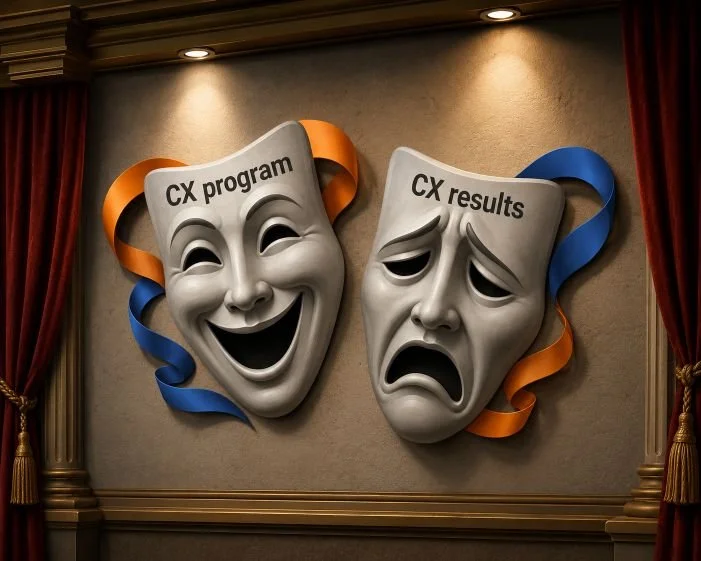
In 2019, researchers Dur and van Lent introduced the provocative concept of socially useless jobs. These are roles that consume time and resources but produce little meaningful value. They are easy to make fun of...until you realize you might be the proud owner of one. At first glance, it’s hard to imagine this applying to Voice of the Customer (VoC) or customer experience (CX) work. After all, these functions are supposed to represent the customer inside the business.
There is an uncomfortable truth in customer experience work that most companies do not like to admit. A lot of “Voice of the Customer” programs are incredibly good at producing artifacts.
Dashboards
Decks
Journey maps
Quarterly readouts
All of them are polished and professional. All… oddly ineffective.
This is where the concept of “socially useless jobs,” becomes uncomfortably relevant. They describe work that exists, gets funded, and looks legitimate, but ultimately creates little real-world value.
Sound familiar? Because when Voice of the Customer (VoC) is disconnected from action, it stops being a strategic function and starts becoming organizational theater.
The Theater of Listening
Most companies do not ignore their customers. In fact, they go out of their way to prove they are listening.
They send surveys
They track NPS
They compile feedback
They present insights
On paper, it looks like customer-centricity is thriving. But here’s the question that matters: What actually changes because of it?
If the answer is “not much,” then the organization isn’t practicing customer experience; it’s performing it.
The warning signs that your VoC has become output instead of outcomes are easy to spot once you know where to look:
Surveys that are sent regularly but rarely lead to visible changes in product, service, or messaging
NPS scores are tracked religiously, but no one owns fixing the drivers behind them
Customer insights shared in presentations that generate discussion—but no decisions
The same customer pain points show up quarter after quarter.
Feedback is collected centrally but dies in silos
None of this work is inherently wrong. In fact, it is often done by smart, capable teams. But the system in which they operate rewards visibility over impact. So, the work keeps flowing—while the experience stays stuck.
Customer experience teams face a parallel issue: the more strategic the work sounds, the easier it is to mistake it for progress.
Journey maps get more detailed
Personas get more refined
Workshops get more engaging
And yet… customers are still frustrated, because deliverables are not outcomes. Outcomes happen through execution of the data. Most organizations do not lack customer insight. They lack the structure to act on it. Common gaps include:
No clear ownership for turning feedback into change
CX positioned as an advisory function instead of an operational driver
Leadership alignment in principle—but not in priorities or incentives
Effort spread across too many initiatives with no measurable impact
In this environment, VoC becomes a safe function: it surfaces problems without forcing the organization to solve them. Which is exactly how useful work turns into “socially useless” work.
The Fractional CX Perspective: Less Theater, More Traction
This is where a fractional CX model tends to challenge the status quo.
Because the goal is not to build a bigger VoC program—it is to make it matter. That usually means:
Narrowing focus to a small number of high-impact customer problems
Connecting feedback directly to operational and financial outcomes
Assigning ownership across the business, not just within CX
Prioritizing changes that customers will actually notice
Closing the loop—internally and externally
In other words, shifting from insight generation to decision activation.
A Simple (and Slightly Brutal) Test
If you want to know whether your VoC or CX efforts are working, ask this: “If we stopped doing this tomorrow, would anything about the customer experience actually get worse?”
If the answer is no, then the work may be creating alignment slides, not customer value. And customers are remarkably good at noticing the difference. Customer experience should be one of the most useful functions in a business. It sits at the intersection of what customers need and how companies operate.
The goal is not to listen more. It is to listen to the correct voices and make that listening count.