
Benefits of hiring a fractional CX strategist
In today's competitive marketplace, customer experience (CX) has become one of the most important drivers of growth, retention, and profitability. Companies invest heavily in marketing, sales, product development, and operations, yet many struggle to understand exactly how customers perceive their interactions with the organization.
The challenge is not a lack of interest in customer feedback. Most companies recognize the value of understanding customer needs and expectations. The challenge is finding the time, expertise, and resources necessary to conduct meaningful Voice of the Customer (VOC) research while still managing day-to-day business priorities.
As a result, many organizations are discovering the advantages of outsourcing some of their customer experience research to a fractional CX consultant. This way they get additional strategic expertise while still keeping their CX program in house and under their control.
Consider the situation facing many marketing and customer-facing departments today. Teams are expected to manage brand strategy, digital marketing, lead generation, content creation, customer communications, product launches, and performance analytics. Adding sophisticated customer experience research to an already full workload can stretch internal resources to the breaking point.
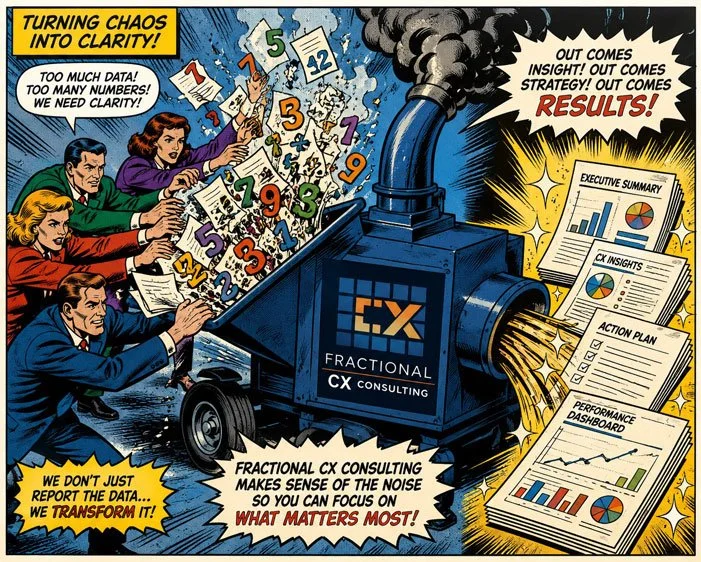
When this happens, customer research often becomes reactive rather than strategic. Surveys are sent without clear objectives. Data is collected but not analyzed deeply. Valuable customer insights remain buried in spreadsheets instead of driving business decisions. KPI’s check a box that has no real-world action associated with it.
The fractional consulting model allows organizations to access executive-level customer experience expertise without the cost and commitment of a full-time executive hire. Among the benefits are the following:
Flexible expertise and accountability
Companies gain access to experienced CX leadership on a flexible basis, enabling them to improve customer insights, operational effectiveness, and business performance while maintaining budget flexibility. They can ensure that the program is accountable and actionable in the real world!
Most organizations do not require a full-time customer experience researcher every day of the year. However, they do need access to those skills periodically. The fractional model allows companies to obtain high-level expertise exactly when needed without adding permanent headcount.
Objectivity
Internal teams often become immersed in organizational assumptions, processes, and culture. Over time, it can become difficult to view the customer journey through a truly unbiased lens. A fractional consultant brings an outside perspective, helping organizations identify friction points, service gaps, communication breakdowns, and unmet customer needs that internal teams may overlook.
This external perspective is particularly valuable because customer experience problems rarely exist in isolation. A customer complaint may stem from marketing promises, operational processes, technology limitations, or employee training issues. An experienced fractional consultant can connect these dots across departments and uncover root causes rather than simply documenting symptoms.
Specialized expertise and coaching
Effective customer experience research involves much more than distributing surveys. It requires expertise in survey methodology, customer journey mapping, segmentation analysis, Voice of Customer programs, customer satisfaction measurement, Net Promoter Score (NPS) analysis, customer effort studies, qualitative interviews, and data interpretation.
Research conducted by customer experience industry experts consistently demonstrates the relationship between customer experience and business performance. Organizations that effectively measure and act on customer feedback often experience higher customer retention, increased loyalty, stronger referral rates, and improved operational efficiency. The challenge lies not in recognizing the importance of customer experience, but in developing a disciplined approach to measuring and improving it.
Speed
Building an internal CX research capability requires investments in methodology, technology, reporting frameworks, and staff training. A fractional consultant arrives with proven processes, established best practices, and experience gained from working across multiple industries and business environments.
Rather than spending months developing a research program from scratch, organizations can often begin gathering actionable customer insights within weeks.
Experienced CX consultants can help organizations rapidly identify operational inefficiencies, customer pain points, and opportunities for improvement. Because these consultants have worked with a variety of businesses, they frequently recognize patterns and solutions that internal teams have not yet considered.
Cost efficiency
A fractional consultant provides access to senior-level strategic guidance at a fraction of the cost. Companies can scale the engagement based on their needs, whether they require support for a specific project, quarterly customer studies, journey mapping initiatives, or ongoing Voice of Customer programs.
The aim of a fractional consultant is not to load you up with new systems. In fact, they do the opposite! They often work with making your existing systems more efficient and effective.
Allows internal teams to focus on what they do best
Marketing departments can concentrate on growth initiatives. Operations teams can focus on execution. Customer service leaders can concentrate on employee development and service delivery. Meanwhile, the fractional consultant manages the research process, gathers customer insights, analyzes findings, and delivers strategic recommendations.
This division of labor often produces better outcomes for everyone involved.
The most successful customer experience programs are not those that simply collect feedback. They are the programs that transform customer insights into business action. Fractional consultants help bridge that gap by translating research findings into practical recommendations that executives can implement.
In an economy where products and services are increasingly similar, customer experience has emerged as one of the few sustainable competitive advantages. Organizations that understand their customers deeply and respond effectively to their evolving needs position themselves for long-term success.
Whether the goal is improving customer retention, increasing satisfaction, reducing churn, strengthening loyalty, enhancing digital experiences, or identifying opportunities for growth, a structured customer experience research program provides the data necessary to make turly data-driven decisions. With all the other fires teams have to put out during the day, a fractional’s job is to make sure there is someone accountable to the CX program and making sure its goals are met.