
Can you trust NPS? How actionable are intentions?
Asking your customers “How likely are you to recommend us to others?” may not give you the actionable information you think. Many companies based their entire customer satisfaction program on this question. Human beings are incredibly complex.... and they unintentionally lie... unfortunately, most often to themselves. If they say they plan to do something, do they mean it?
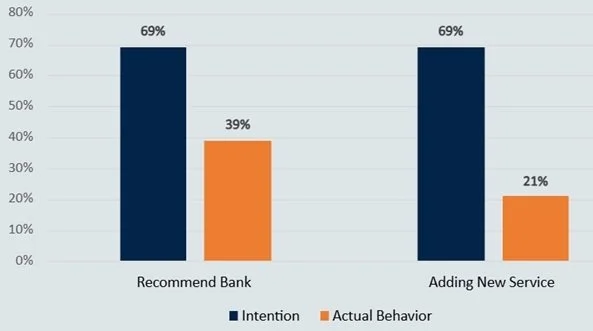
A while back I did a study to see how trustworthy customers are in following up on their intentions. We surveyed a group of banking customers and asked the standard question of “How willing are you to recommend your bank to others” along with their intention to adopt new products and services. The following year we asked them whether they had actually recommended someone to the institution and/or had adopted a new product or service in the last year. As you can see from the chart below, there was indeed a difference between intention and behavior.
Don’t leave customer “good will” on the table
The chart contrasts “promoters” (score of 9 or 10 on a 10-point scale) for both willingness to recommend and likelihood to adopt new services with their actual behavior of recommending and adopting new services. There was a stark difference between behavior and intentions. Just under half of the customers who said they would recommend the bank did so while those adding a new service was less than one-third.
This experiment showed that there is a substantial difference between intentions and actual behavior. Relying on a single-measure summary statistic leaves much customer behavior unaccounted for. This is unfortunately the case for many popular customer satisfaction models. In addition, a survey that just measures intentions is limited in that it also does not differentiate between distinct types of customer behavior. A customer displays a high likelihood for “retention loyalty” when they indicate a willingness to refer your business to others. This is different from “purchasing loyalty”, which is shown through adopting new products and services. By measuring behavior, you can easily differentiate their actual loyalty through their actions.
CX programs should try to provide direction and make marketing efforts clearer. By recognizing and accounting for the gap between intention and actual behavior, you get a clearer picture of actual customer behavior and make those marketing projections more accurate. Willingness to recommend indicates the level of “good will” that customers have for your company. Marketing efforts should focus on diminishing the gap between intention and actual behavior in order to capitalize on that existing customer good will craft messages that will turn that good will into action. This will help ensure that potential product adoptions and recommendations are not “left on the table.”